
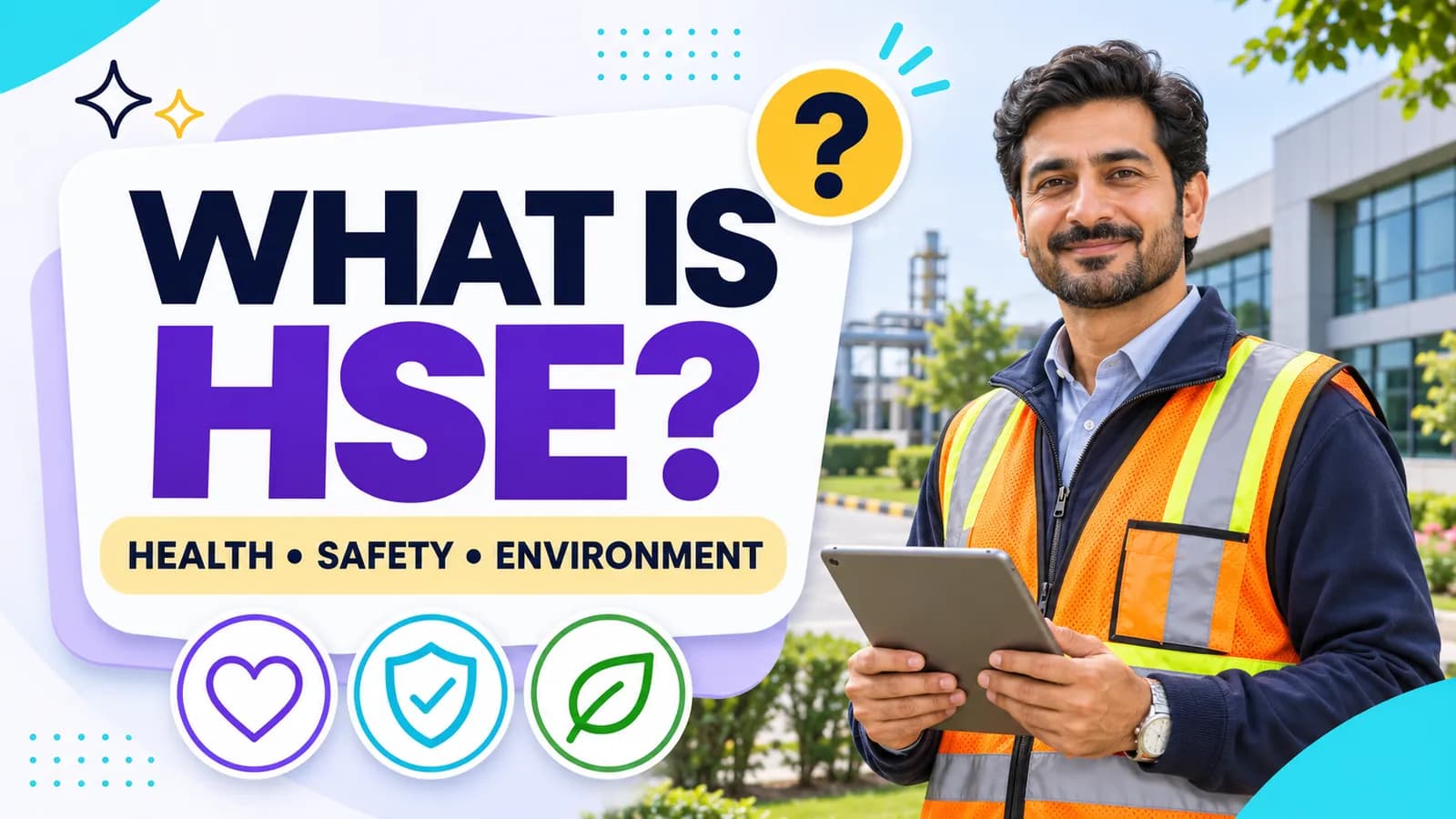
What Does HSE Mean? Health, Safety and Environment Roles Explained
HSE means Health, Safety and Environment. In a workplace, it describes the coordinated work of preventing work-related injury and ill health while managing environmental impacts. For a new employee or someone considering a safety career in Pakistan, the useful question is what each part covers and who is responsible for it.
HSE is a function, not a single qualification or job title. The exact responsibilities depend on the employer, sector, site and applicable jurisdiction. This introductory guide explains terminology and organisational roles; it does not provide technical authorisation for hazardous work.
What the three parts of HSE cover
Health, safety and environment overlap, but they ask different questions. Treating them as separate lenses helps a team avoid missing a slow-developing health problem while concentrating on immediate injuries.
Area | Main question | Illustrative workplace example |
|---|---|---|
Health | Could work damage a person’s physical or mental health? | Understanding exposure to noise, dust or demanding work patterns. |
Safety | Could an activity cause injury or an incident? | Managing interactions between pedestrians and moving vehicles. |
Environment | How could operations affect air, water, land or resources? | Preventing unnecessary material waste and releases to drains. |
The ILO’s explanation of occupational safety and health centres prevention of workplace accidents and disease. For the environmental dimension, the US EPA’s pollution-prevention guidance explains why preventing pollution at source is different from dealing with waste after it is created. These are useful international explanations, not statements of Pakistani law.
HSE, EHS, SHE and OHS: reading the terminology
Employers may rearrange the letters as EHS or SHE. Read the job description and management-system scope rather than assuming that a different acronym indicates a higher qualification. OHS or OSH focuses on occupational health and safety; environmental management may sit in another department.
There is another important meaning: in British guidance, HSE is the name of the Health and Safety Executive. Its official organisational information concerns the regulator. A reference to “HSE guidance” may therefore mean a publication from that authority, rather than an employer’s HSE department.
Who does what in an HSE system?
A useful way to judge a workplace system is to follow a concern from the person who notices it to the person who can fund and verify the response. The following is an illustrative allocation of work, not a universal legal responsibility chart.
Leadership: sets priorities, provides resources and checks whether important actions are completed.
Operational managers and supervisors: organise the work, communicate applicable arrangements and address issues within their authority.
HSE personnel: advise, coordinate, analyse information and help departments improve their arrangements.
Workers: contribute knowledge about actual work, follow applicable instructions and report concerns through the site’s arrangements.
Specialists: provide competence that a general HSE role may not possess, such as occupational medicine, engineering or environmental assessment.
An HSE officer should not become the default owner of every unresolved problem. If a damaged access route requires a maintenance budget, the action needs an operational owner with authority to arrange the repair. The officer can help track and challenge the response.
A worked example: one issue, three perspectives
Hypothetical example: a warehouse receives a damaged container and notices a small leak. A health question concerns possible exposure; a safety question concerns access and the potential for slips; an environmental question concerns where a release could travel. These questions show why the functions must communicate.
This example is not a spill-response procedure. Staff should use the site’s reporting and emergency arrangements, and the response requires substance-specific information and competent assessment. The learning point is organisational: the issue cannot be closed just because one department has completed its paperwork.
A useful record would identify the concern, the person coordinating the response, the specialist input required and how completion will be checked. It should also prompt a review of receiving and purchasing arrangements if packaging failures recur.
What to learn first if you are starting an HSE career
Begin by understanding the work and how the organisation makes decisions. A certificate can support learning, but it cannot by itself establish competence for every task.
Learn the difference between a hazard, the people who may be affected and the arrangements used to manage risk.
Practise clear factual reporting: what was observed, where, when and who needs to act.
Understand how consultation, incident learning and training records connect with daily work.
Check a course’s syllabus and assessment against the responsibilities you actually want to develop.
For managers seeking introductory safety learning, SIP lists IOSH Managing Safely. Check current entry, delivery and assessment arrangements before enrolling. For workplace application, SIP’s guide to building an HSE training matrix explains how learning needs can be connected to roles and evidence.
Questions to ask before accepting an HSE role
Ask which locations and activities the role covers, who holds operational authority, which specialists are available and how unresolved concerns are escalated. A title such as officer, engineer or manager is not enough to answer these questions.
For Pakistani employment, verify applicable requirements for the location and sector with competent local support. Do not copy a foreign regulator’s duties into a job description and assume that they establish local compliance. Likewise, a voluntary management-system certificate is not a substitute for applicable obligations.
Frequently asked questions
These answers clarify the questions beginners most often need to resolve before choosing their next step.
No. It is an organisational field or acronym. Individual qualifications teach particular knowledge or skills within that field.
No. Health, safety and environmental questions also arise in offices, logistics, manufacturing and other workplaces, although the risks and specialist needs differ.
HSE describes a broader function. A safety officer is a role whose scope is defined by the employer and the applicable requirements.
No. Recruitment also depends on relevant knowledge, experience, communication, role-specific competence and the employer’s requirements.
A practical next step
Write down one health issue, one safety issue and one environmental issue relevant to your workplace. Identify who owns each issue and what evidence would show it has been addressed. This makes the meaning of HSE concrete without confusing awareness with technical authorisation.
Sources checked: 5 November 2026. Illustrative examples are editorial teaching examples, not claims of personal site experience or specialist review.